

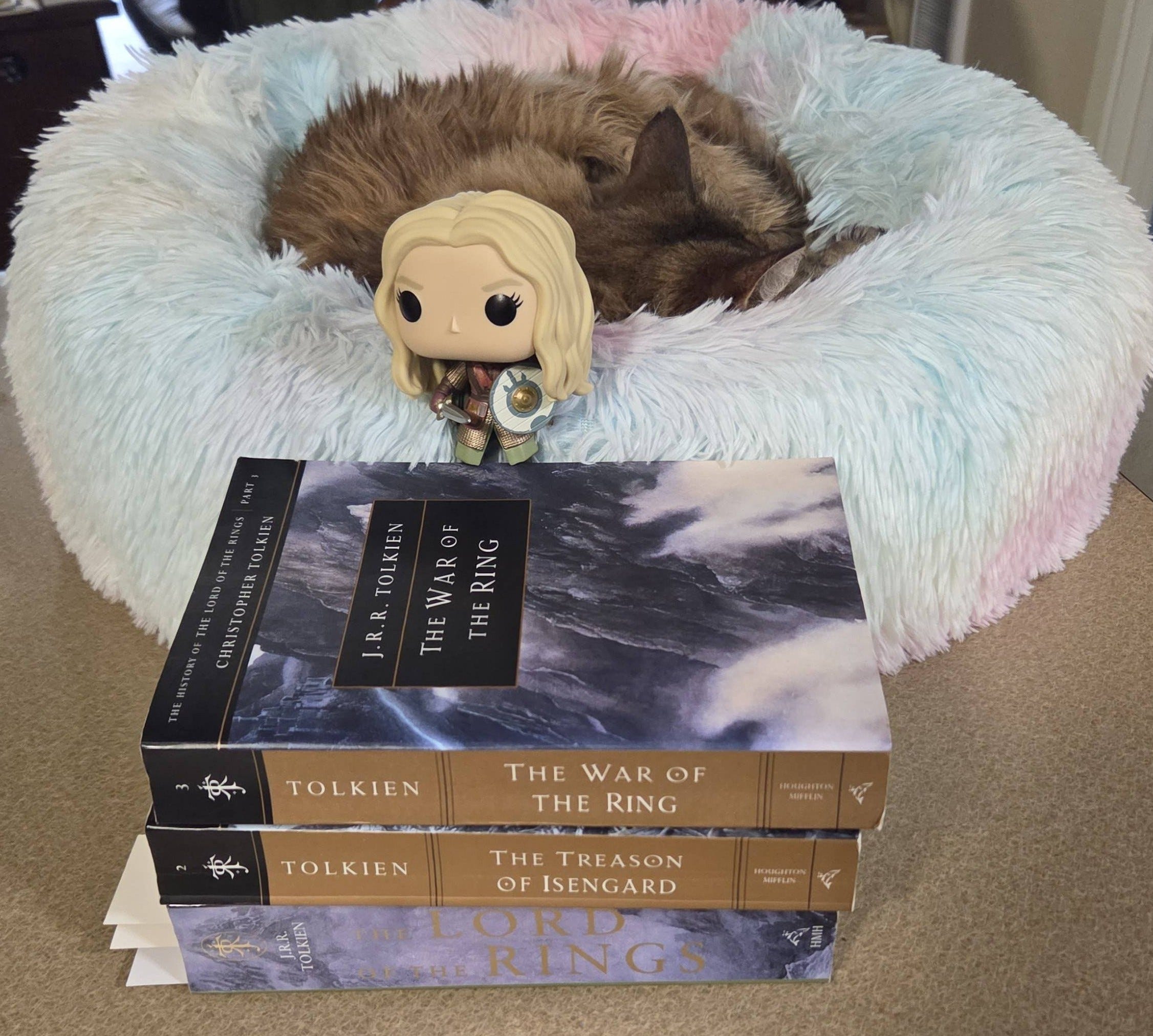
So during the last six months, I’ve been pulling together the bits and pieces of what I’ve started calling the Éowyn project. It is tentacular because it has grown, and it keeps throwing out new branches and leaves (love mixing those metaphor). It started in 2024 with an unplanned series of posts about Éowyn on my newly-acquired Substack.1
The posts were the start of what has become my next big (essay) project (and were originally part of my first book project that I am determined to complete no matter what),2 Webs by Women. I originally planned to have a reader-response and fan-fic oriented chapter about Éowyn in Webs, but, well, some presentations happened, and it just kept expanding, so now I’m pulling the Éowyn material out of the and am going to do an article. Or maybe two.
During the last six months, I’ve been working on transcribing information from the three relevant volumes of the History of Middle-earth: The Treason of Isengard; the War of the Ring; and Sauron Defeated, all on the various versions of Éowyn’s story Tolkien drafted. I had originally thought that I just needed to do Treason and War and did not realize that the drafts relating to the last chapters of RotK were in a third volume (Sauron) which is why only two of the volumes are in my photo above. (I’m also working with excerpts from TT and RotK, specifically Éowyn’s dialogue. I’ll be doing an applied linguistics analysis of agency in the grammar of her dialogue — that’s why I went into HoMe to see how much of those earlier versions had dialogue — but there’s so much in the earlier drafts that I may end up doing that stylistics analysis in one essay and then another analyzing Tolkien’s versions of her because, wow. My transcriptions from the three HoMe volumes total a little over 10K words that consist of JRRT’s drafts (ranging from rough outlines, to multiple drafts that range in depth from overviews to detailed descriptions of actions and dialogue) plus Christoper’s commentary which cover dating, changes, format of drafts (pencil overwritten in ink arch), relative readability of his father’s handwriting, and more; it’s absolutely fascinating (in a messy kind of masochistic way).3
There’s a fair amount of scholarship about Éowyn, but only two publications (that I’ve found so far—if you know of others, please drop the info in a comment!) that draw on the different narrative arcs that Tolkien considered. And what I find rather interesting is that both cite only the draft material from Treason and War: they don’t get into the drafts in Sauron (and that may be why I didn’t realize until LATE in the transribing process that I wouldn’t get all the stuff from those two volumes!).4
David Craig (in 2001) wrote what I consider the first queer analysis of LotR (Frodo and Sam) and one of the best discussions of Éowyn’s importance—all in the context of the changing gender relations in interwar Britain, and using the HoMe. Craig describes the different endings in Tolkien’s early drafts: Éowyn was going to marry Aragorn; or, alternately, ride openly to war openly only to die beside Théoden; only later did her decision to disguise herself as Dernhelm to ride with Merry to war and then to marry Faramir and become a Healer occur. Craig argues that one result of Tolkien’s lengthy and complex (contradictory!) revisions was that Éowyn is “the most developed female character” (14) in the novel.5
More recently (2023), Sara Brown opens her queer analysis of Éowyn’s gender fluidity and female masculinity (drawing on Butler’s, Halberstam’s, and Kristeva’s work) with a description of the various iterations Tolkien considered followed by this superb summing up of the impact of the one of the earlier drafts:6
This is a fascinating early draft, for so many reasons, including the fact that some of the language is familiar from the final published version. Here, Éowyn is not Dernhelm but simply Éowyn. In addition, she is powerfully victorious, framed by the light of the day, a terrifying foe to the Harad that face her. This is a different Éowyn to the one we are more familiar with, not least because she has not had to fight for her place as a Rider, nor has she had to overcome the same difficulties as our Éowyn. For one thing, the Éowyn of The Lord of the Rings performs her masculinity not just as a warrior, but as a male warrior – Dernhelm – and this performance of gender is something I want to explore further. (1-2).
I admire Craig’s and Brown’s scholarship immensely and consider that I am building on their work while drawing on some different methodologies.
I am interested in going more in-depth into the multiple versions of Éowyn and foregrounding them as equally important (to me as a reader) as the published version. Part of my reason is doing for is noticing, due to my bibliographic work, that because, while she is a character embedded in the most overtly medieval culture of Middle-earth, she is also the character who has been at the center of many of the discussions/debates about feminist readers, and a good deal of the scholarship on her reflects the modern context (and even some postmodern approaches).
Unlike other powerful female characters (Goldberry, Arwen, and Galadriel) whose power is more spiritual in nature, Éowyn exercises her power in the material world in ways that I think read as more “feminist” (by various definitions) to some.7
Yet there is also a wide range of contradictory claims about Éowyn.8 My preliminary checklist of periods and approaches (not the specific arguments) in the scholarship about Éowyn includes:
Classical: Librán-Moreno
Christian/Biblical: Coutras; Enright; Filipczak; Fredrick and McBride; Roberts (2014; 2022)
Medieval: Chance9; Donovan; Holmes; Honegger; Linton, Wallace
Modern/Modernist: Benvenuto; De Souza; Hatcher; Jensen; Johnson; Schlesinger; Smith; Trenk
Gender and/or Queer: Brown; Craig; Foster; Holmes, Reid, Sheppard
Film: Dodd, Thum
Stylistics: Drout; Reid
The existence of contradictory claims is not surprising given the contradictions in Tolkien’s text (see Flieger, “The Arch and the Keystone.”), but I think that the range or scope of analysis based in different historical contexts by scholars of such a range of period training in addition to contradictory readings relating to the gender and power of female characters is largest in the scholarship about Éowyn.
So I plan to take a different approach to the multiple versions (all 10K words of drafts by JRRT and commentary by CJRT): rather than summarize it in the service of an overall analysis of the “final” version, I am going to try to convey the absolute messiness of Tolkien’s process and how that messiness which includes changes of names, changes in dialogue, and, most importantly, changes in Éowyn’s story are linked to changes in other characters’ stories (especially but not only Merry’s). Rather than a smooth revision/narrative progression, I envision the process as a kaleidoscopic one (shifts in one character or plot point change other characters or plot points).
In addition, I do not assume that Tolkien’s published work is somehow “perfect” in the sense of revealing (accurately) some specific intention that was firmly in place from the start of the writing process. I’m firmly in the “author is dead, Jim” critical theory camp, with the clarification that “author” is a social construction or category applied to a human being.
Tolkien was juggling a lot of characters and plot strands in the chapters of the book which deal with Éowyn and Rohan (a LOT of CJRT’s notes are about the messiness of drafts, the lack of clear dating of material, and at what point in the whole messy period ‘final’ decisions were made). In a lot of the sections I was transcribing, Pippin is still calling Aragorn “Trotter”! And at times, CJRT notes that changes were made on the final proof copies (and that’s not even getting into the decades that Tolkien then spent trying to “finalize” the Silmarillion material—and that is one topic I know I will never engage with!).
I guess the shortest way for me to describe the way I see my goal at this point is that I am trying to convey a sense of the friction and multiple/contradictory possibilities of Éowyn as well as what I think is a tension Tolkien experiences about the whole issue of “women warriors” (i.e. whether there were historical women warriors, or only mythological ones AKA “Amazons”), and what role, if any women have during war, roles that were changing during Tolkien’s lifetime (see the publications by Anika Jensen, Lynn Schlesinger, and Melissa Smith).
And more. But of course at the heart of it all is the fact that I have been in love with Éowyn since I was ten years old, and at this point in my life, sixty years after I first discovered her, in the midst of what is happening globally, I seem to find myself with a whole lot more to say that I realized the first time I wrote about her (in my 2013 essay).
And, as my new profile pic (of a refrigerator magnet I found!) says, I have no more fox to give!
All my Substack posts which mention Éowyn: either in the context of Jackson’s film adaptation, scholarship, or, in one case, the Naming of Storms!
Reid, Robin Anne. “Seeing RotK in December 2003.” Writing from Ithilien, 6 May 2024, robinareid.substack.com/p/seeing-rotk-in-december-2003. [This post although posted in Substack in 2024 copies over entries from my Dreamwidth that I made in 2003 after first seeing RotK; it does not focus entirely on Éowyn, but since The Éowyn Project will probably involve some discussion of Film!Éowyn, I’m including it in this list.
Reid, Robin Anne. “Books, Films, Adaptations & Reader Responses 6/8.” Writing from Ithilien, 29 Aug. 2024, robinareid.substack.com/p/books-films-adaptations-and-reader-0de.
Reid, Robin Anne. “Books, Films, Adaptations & Reader Responses, 7/8.” Writing from Ithilien, 30 Aug. 2024, robinareid.substack.com/p/books-films-adaptations-and-reader-c14.
Reid, Robin Anne. “Éowyn as An Exemplar of Systemic Failures to ‘See’ Women.” Writing from Ithilien, 30 Sept. 2024, robinareid.substack.com/p/eowyn-as-an-exemplar-of-systemic.
Reid, Robin Anne. “Storm Éowyn.” Writing from Ithilien, 26 Jan. 2025, robinareid.substack.com/p/storm-eowyn.
Reid, Robin Anne. “Handout on Scene 20 (EE) The Two Towers.” Writing from Ithilien, 15 May 2026, robinareid.substack.com/p/handout-on-scene-20-ee-the-two-towers.
Reid, Robin Anne. “The Online Supplement.” Writing from Ithilien, 23 Jan. 2025, robinareid.substack.com/p/the-online-supplement.
The “Online Supplement” supplements this “Response” published in Mythlore:
Reid, Robin Anne. “‘Perilous and Fair’ in ‘A Bleak, Barren Land: A Feminist Responds to Dylan Lee Henderson’s Essay.” Mythlore, vol. 43, no. 2, article 19, 2025 Spring-Summer, pp. 253-269, dc.swosu.edu/mythlore/vol43/iss2/19/.
The response was written because Henderson’s essay was just too sexist to let go by without comment:
Henderson, Dylan L. “’A Bleak, Barren Land’: Women and Fertility in The Lord of the Rings.” Mythlore, vol. 42, no. 1, 2023, article 6, https://dc.swosu.edu/mythlore/vol42/iss1/6/.
I had an earlier book project (in the 1990s), but my department’s tenure and promotion standards in regard to evaluating research privileged short-term publications (essays in journals, chapters in anthologies). It was a point system; it sucked; what they finally replaced it with sucked even more; the origin of the problem was that small regional university did not particularly value scholarship for most of its history, assigned four classes a semester, but then in the mid-1990s decided they wanted to get more research oriented, but all gods and goddesses forbid they lighten the teaching load! So while I worked on a book project (a Borderlands [Gloria Anzaldúa’s intersectional feminist theory] analysis of feminist speculative fiction), it took longer than necessary to finish because I had to keep publishing shorter stuff (and you don’t want to have too much of a book project already in print before publishing the book). Toss in some of the low-level (meaning work-intensive with no university support) administrative work I volunteered for plus the Jackson/Tolkien/fanfic obsession that hit in 2003, and, well, I just never finished it. I don’t think I ever shall because I’m too deep in Tolkien scholarship and too out of date with regards to feminist speculative fiction and the relevant scholarship for that genre (although a Borderlands analysis of some of Tolkien’s legendarium MIGHT be possible).
Basic Word word count from the three volumes so far (I suspect there will be backtracking and double-checking): there are probably thousands of words devoted to Faramir in War (I checked all the indexed pages), but I’m not transcribing or counting those because they are all related to his encounter with Frodo and Sam, and his return to the City, his interactions with his father, his injury, etc. — that is, the drafts where he and Éowyn meet are in Sauron and from Christopher’s notes, those earlier drafts were fairly close to what eventually ended up in the published version (meaning no MAJOR changes such as the different futures he planned for Éowyn). I mean, they’d be worth looking at for an anlysis of Faramir’s develoment, but aren’t that relevant for my purpose!
Sauron Defeated (E and F) 2018
Faramir (Treason) 177
Eowyn (Treason) 1050
Eowyn (War) 7040
TOTAL: 10285
The Éowyn Project Working Bibliography (in progress)
Benvenuto, Maria Raffaella. “Against Stereotype: Éowyn and Lúthien as 20th-Century Women.” Tolkien and Modernity I, edited by Frank Weinreich and Thomas Honegger, Walking Tree, 2006, pp. 31-54. Cormarë Series 9.
Brown, Sara. “Éowyn it was, and Dernhelm also”: Reading the ‘Wild Shieldmaiden’ Through a Queer Lens.” Journal of Tolkien Research, vol. 18, iss. 2, article 4, 2023, scholar.valpo.edu/journaloftolkienresearch/vol18/iss2/4.
Canavan, Gerry. “The Éowyn Mystique.” Los Angeles Review of Books. 10 Jan. 2025, lareviewofbooks.org/article/the-eowyn-mystique/.
Chance, Jane. Tolkien, Self and Other: “This Queer Creature.” Palgrave, 2016. The New Middle Ages. Series Editor: Bonnie Wheeler.
Coutras, Lisa. Tolkien’s Theology of Beauty: Majesty, Splendor, and Transcendence in Middle-Earth. Palgrave, 2016.
Craig, David M. “Queer Lodgings’: Gender and Sexuality in The Lord of the Rings.” Mallorn, vol. 38, Jan. 2001, pp. 11–18, journals.tolkiensociety.org/mallorn/article/view/145 Rpt. “Queer Lodgings: Gender and Sexuality in The Lord of the Rings - Reprinted with a New Introduction by the Author.” Mallorn, no. 61, 2020, pp. 20–29.
Croft, Janet Brennan, and Leslie Donovan, editors. Perilous and Fair: Women in the Works and Life of J. R. R. Tolkien. Mythopoeic P., 2015.
De Souza, Robert Augusto. “(Re)Assessing Gender Roles At War Through Tolkien’s Legendarium: Agency, Choice And Refusal In The Tales Of Arwen Undómiel And Éowyn Of Rohan.” Anamorphosis: Revista Internacional de Direito e Literatura, vol 7, no. 1, janeiro--junho 2021, pp. 115-37, doi: 10.21119/anamps.71.
Dodds, Alice Rose. “LOTR: Éowyn’s Most Undermining Moments.” Game Rants, 2 Apr. 2022, gamerant.com/lotr-eowyn-undermining-moments/. Archive version at: archive.ph/wip/Zq2bX.
Donovan, Leslie A. “The Valkyrie Reflex in J. R. R. Tolkien’s The Lord of the Rings: Galadriel, Shelob, Éowyn, and Arwen.” Tolkien the Medievalist, edited by Jane Chance, Routledge, 2003, pp. 106–32. Rpt. Croft and Donovan, pp. 221–57.
Drout, Michael D. C. “Tolkien’s Prose Style and its Literary and Rhetorical Effects.” Tolkien Studies, vol. 1, 2004, pp. 137-63.
Enright, Nancy. “Tolkien’s Females and the Defining of Power.” Renascence: Essays on Values in Literature, vol. 59, iss. 2, Winter 2007, pp. 93-108. Rpt. JRR Tolkien’s The Lord of the Rings, edited by Harold Bloom. New Edition. Infobase Publishing, 2008, pp. 171-186.
Filipczak, Dorota. “Éowyn and the Biblical Tradition of a Warrior Woman.” Text Matters: A Journal of Literature, Theory and Culture, vol. 7, 2017, pp. 405-15.
Fredrich, Candice, and Sam McBride. Women Among the Inklings: Gender, C.S. Lewis, J.R.R. Tolkien, and Charles Williams. Greenwood P, 2001. Contributions in Women’s Studies, No. 191.
Foster, Gavin. “Éowyn and/or Dernhelm: Reading Éowyn’s (Trans)Masculine Disguise.” Queer Approaches to Tolkien: Essays on the Many Paths to Middle earth, edited by Robin Anne Reid, Christopher Vaccaro, and Stephen Yandell, McFarland, 2025, pp. 92-106.
Hatcher, Melissa McCrory. “Finding Woman’s Role in ‘The Lord of the Rings’.” Mythlore, vol. 25, no. 3, article 5, 2007, dc.swosu.edu/mythlore/vol25/iss3/5/ pp. 43-54.
Hesser, Katherine. “Éowyn.” J. R. R. Tolkien Encyclopedia: Scholarship and Critical Assessment, edited by Michael D. C. Drout, Routledge, 2007, pp.168-69.
Holmes, John. “The Other as Kolbítr: Tolkien’s Faramir and Eowyn as Alfred and Æthelflæd,” Tolkien and Alterity, edited by Christopher Vaccaro and Yvette Kisor, Palgrave, 2017, pp. 241-61.
Honegger, Thomas. “Éowyn, Aragorn and the Hidden Dangers of Drink.” Inklings: Jahrbuch für Literatur und Ästhetik, vol. 17, 1999, pp. 217-225.
Jensen, Anika. “Flowers and Steel: The Necessity of War in Feminist Tolkien Scholarship.” Tolkien Studies, vol. 16, 2019, pp. 59–72.
Johnson, Brent D. “Éowyn’s Grief.” Mythlore, vol. 27, no. 3, article 15, 2009, pp. 117-27, dc.swosu.edu/mythlore/vol27/iss3/15.
Librán-Moreno, Miryam. “Greek and Latin Amatory Motifs in Éowyn’s Portrayal.” Tolkien Studies, vol. 4, 2007, pp. 73-97.
Linton, Phoebe C. “Speech and Silence in The Lord of the Rings: Medieval Romance and the Transitions of Éowyn.” Croft and Donovan, pp. 258-280.
Reid, Robin Anne. “Light (noun, 1) or Light (adjective, 14b)? Female Bodies and Femininities in The Lord of the Rings.“ The Body in Tolkien’s Legendarium: Essays on Middle-Earth Corporeality, edited by Christopher Vaccaro, McFarland, 2013, pp. 98-118.
Roberts, Adam. “Chapter 32 Women.” A Companion to J. R. R. Tolkien, edited by Stuart D. Lee, Wiley Blackwell, 2014, pp. 473-87.
Roberts, Adam. “Chapter 35: Women.” A Companion to J. R. R. Tolkien, Second edition, edited by Stuart D. Lee, Wiley Blackwell, 2022, pp. 448-59.
Schlesinger, Lynn. “Angels of Care and Houses of Healing in World War I: Their Possible Influence on Tolkien’s The Lord of the Rings.” “Something Has Gone Crack”: New Perspectives on J.R.R. Tolkien in the Great War, edited by Janet Brennan Croft and Annika Röttinger, Walking Tree Press, 2019, pp. 287-318. Comarë Series No. 41.
Sheppard, Jackie. “What is Unwritten May Yet Resonate: In Search of Female A-spec Resonances in Tolkien.” Journal of Tolkien Research, vol. 24, iss. 1, article 7, scholar.valpo.edu/journaloftolkienresearch/vol24/iss1/7.
Smith, Melissa. “At Home and Abroad: Éowyn’s Two-fold Figuring as War Bride in The Lord of the Rings,” Mythlore, vol. 26, no. 1, article 12, 2007. Rpt in Croft and Donovan, pp. 204-17, dc.swosu.edu/mythlore/vol26/iss1/12/.
Thum, Maureen. “The ‘Sub-Creation’ of Galadriel, Arwen, and Éowyn: Women of Power in Tolkien’s and Jackson’s The Lord of the Rings.” Tolkien on Film: Essays on Peter Jackson’s The Lord of the Rings, edited by Janet Brennan Croft, Mythopoeic P, 2004, pp. 231-56.
Trenk, Christian S. “‘And each day after they did likewise.’ Looking at Life Together as the Fulcrum of Éowyn’s and Faramir’s Love Story,” Journal of Tolkien Research, vol. 19, iss. 2, article 2, 2024, scholar.valpo.edu/journaloftolkienresearch/vol19/iss2/2.
Wallace, Anna. “A Wild Shieldmaiden of the North: Éowyn of Rohan and Old Norse Literature.” Philament, vol. 17, 2011, pp. 23-45.
Note: most of the publications here focus solely on Éowyn, but there are some that include her amongst other major female characters, or, in the case of monographs, have a single chapter on female characters/women.
Craig, David M. "'Queer Lodgings': Gender and Sexuality in The Lord of the Rings." Mallorn, vol. 38, Jan. 2001, pp. 11–18. journals.tolkiensociety.org/mallorn/article/view/145 Rpt. “Queer Lodgings: Gender and Sexuality in The Lord of the Rings - Reprinted with a New Introduction by the Author.” Mallorn, no. 61, 2020, pp. 20–29. You can access the reprint with new introduction, and an article by me about WHY Craig’s essay is so important here: journals.tolkiensociety.org/mallorn/issue/view/62/63.
Brown, Sara. “Éowyn it was, and Dernhelm also”: Reading the ‘Wild Shieldmaiden’ Through a Queer Lens.” Journal of Tolkien Research, vol. 18, iss. 2, article 4, 2023, scholar.valpo.edu/journaloftolkienresearch/vol18/iss2/4.
In a stylistic analysis of female characters, I argue that “While, as Donovan notes, [Éowyn] is associated with light as are Goldberry, Arwen, and Galadriel, the associations seem more natural than supernatural. She is lit by the sun; she does not shine through her own agency. However, her agency is clearly established: she is the grammatical subject of nearly 60% of the clauses in the excerpts, and she acts more in the material world, destroying the supernatural figure of the Ringwraith with the help of a hobbit, his blade, and her sword” (Reid 2013 105). I do a queer (resistant) reading of her in the same essay.
Reid, Robin Anne. "Light (noun, 1) or Light (adjective, 14b)? Female Bodies and Femininities in The Lord of the Rings,” The Body in Tolkien’s Legendarium, edited by Christopher Vaccaro, McFarland, 2013, pp. 98-118.
In contrast to my openly-declared feminist and queer reading, a forthcoming essay by Craig Franson includes information about how women in the Italian Fascist movement published their version of a feminist fanzine which they dedicated to and titled Eowyn (Guera).
Guerra, Nicola. “Eowyn Magazine (1976-1982) and the Personalizing Feminism of Neo-Fascist Women.” The Italian Far Right from 1945 to the Russia-Ukraine Conflict, Routledge Studies in Fascism and the Far Right, series editors Nigel Copsy and Graham Macklin, Routledge, 2023, pp. 184-210
I characterize Jane Chance’s monograph, Tolkien Self and Other: “This Queer Creature” in the medieval category of scholarship, not in the gender/queer category, because it is the straightest queer theory publication in Tolkien scholarship (and perhaps beyond) that I have ever read. “Queer,” in Chance’s and Tolkien’s quote is the definition of a range of alterities that does not include sexualities. As I say in an earlier Substack post on the “Many Meanings of Queer” (warning for extensive OED discussion): “The aspects of Tolkien’s identity that [Chance] considers to be “queer” are: his “secret vice” (inventing languages); his birth in South Africa; his parents’ deaths; his humility; his physical build; his religion; his scholarship; his family background as “rustics”; his adaptations of the medieval in his fiction; and his "aesthetic of a 'queer medievalism'" (p. xii, Chapter 2: “Forlorn and Abject: Tolkien and His Earliest Writing”).”
Here is the first passage that tipped me off to the extent that Chance is working with a somewhat idiosyncratic, to say the least, definition of “queer”:
And what might all this contribute to the newly evident critical interest in Tolkienian queerness? Let us begin to account for resonances by asking more focused questions: if medievalists are queer (other), and Tolkien was a medievalist, was he queer? (And who knows if he was anything but heteronormative in his sexual practices and fantasies?). Echoing Pugh, what was his gender? (Might he have been a Lesbian born in a man’s body? A hint of transgender/cis?) If we think of queer “Tolkien” as embodied in the works he inscribed, perhaps it is possible to understand a medievalist who constantly disturbed (or “queered”) his own identity, from one moment to another, whether as public scholar or as private fantasist. And he queered the medieval by remaking it his own imaginary: for example, in a unique contemporary parodic genre, with peasant “Farmer Giles of Ham” who is no romance knight, finding a space in the antiheroic modern (again, as queered by Tolkien the medievalist). Tolkien also queered his heteronormative marriage and family in his desire to join masculine subgroups like the Inklings (and the more youthful harbingers of those groups) in which he displayed his own more private investment in fantastic and phantasmal fictions. And we cannot forget, what is Tolkienian? We have a corpus of works that exist in seemingly infinite variations and revisions, many published by his son Christopher, after all. How can we say, of Tolkien’s many moments, of his varied images, which are the most queer, that is, the most medieval? How does Queer Theory enter into the study of Tolkienian medievalism? (pp. 11-12, Chapter 1, “Introduction: ‘This Queer Creature,’” emphasis added)
But then it could be my bias as a postmodernist (period training) and an actual queer (asexual) autist and scholar drawing on different queer theorists than the queer medievalist theory developed by Tison Pugh that Chance draws on. My feminist criticism of Chance’s monograph is that eight of her nine chapters are devoted to male characters, with all the women shoved into one, in order to defend him (the human being) from the “decades of criticism” about “his alleged misogyny” (177). I think that Chance mostly ignores/downplays the existence of feminist criticism that does not fit this stereotype while going on to argue that his medieval scholars about “female figures with whom he sympathized” and identifies with leads to “general empathy for alterity of all types, which would, of course include women” (178-79).
Love this project! Teaching the Tolkien class so often the last ten years I have really become fascinated by the fact that "our" copy of the Red Book was specifically in the possession of Eowyn's descendants for a century, who are known to have made at least some changes to the text (most notably making sure Arwen's tragic ending is recorded). Her life, and the contradictory way the people who come later remember her, is such an interesting loose end.
It's such a fascinating project ! I'm looking forward to read more about it. Thank you so much.